
If you searched “Azure Synapse vs Snowflake,” you’re asking the right question with slightly outdated terms. Microsoft is actively transitioning Azure Synapse Analytics toward Microsoft Fabric. So the real platform decision in 2026 is Fabric vs. Snowflake — and if you’re currently running Synapse, there’s a second question underneath that: which migration path costs less to execute.
Both are covered below. They’re related but not the same decision, and we’ve split them accordingly.
Data-Sleek has been implementing Snowflake environments for mid-market enterprises for over eight years, with more than thirty combined years of database architecture experience across healthcare, insurance, construction, and higher education.
The Fabric vs. Snowflake decision is one we work through with clients every week, across organizations where the wrong platform choice carries real compliance, cost, and operational consequences. The decision framework below is built around which platform actually fits your architecture and business context.
First, the Real Question: Snowflake or Microsoft Fabric?
In 2026, if you are evaluating platforms for a three-to-five-year horizon, you are not choosing between Azure Synapse and Snowflake. You are choosing between Microsoft Fabric and Snowflake.
Microsoft Fabric is a software-as-a-service analytics platform that unifies data engineering, data warehousing, real-time analytics, and business intelligence under a single governed environment. It absorbs the capabilities that Azure Synapse delivered as a PaaS product and reimagines them under a cohesive SaaS layer built on Microsoft OneLake.
Microsoft has not announced a forced deprecation timeline for the product as a whole as of mid-2026. Specific components are already on retirement paths, including Synapse Data Explorer, which reached end of life in October 2025, and Synapse Link for Azure Cosmos DB, which is no longer supported for new projects. New enterprise investments should still be evaluated against Fabric’s roadmap.
Microsoft’s Fabric Migration Assistant for Data Warehouse became generally available in October 2025, supporting automated schema conversion, stored procedure migration, and AI Copilot assistance for compatibility errors. The migration path from Synapse to Snowflake is real too, but materially more complex, as the migration section below covers.
Platform status at a glance
| Platform | Status | Best for |
|---|---|---|
| Azure Synapse Analytics | Active, transitioning | Existing Synapse workloads in maintenance or transition |
| Microsoft Fabric | GA, strategic direction | Microsoft-first new builds with Azure ecosystem investment |
| Snowflake | GA, independent | Cross-cloud deployments or organizations without deep Microsoft ecosystem dependency |
Architecture Differences That Actually Matter
The architecture of a data platform determines how it scales, how it handles concurrent workloads, how it governs data, and how it integrates with your existing stack. Feature lists obscure these differences, which is why data architecture consulting starts with the architectural fit before evaluating any specific platform.
How Snowflake’s Architecture Was Designed
Snowflake was designed from scratch as a cloud-native SQL engine — not derived from Hadoop, PostgreSQL, or any prior big data platform — a design documented in the peer-reviewed 2016 SIGMOD paper by Dageville et al. The architecture separates three layers completely: storage, compute, and cloud services. Storage lives in object storage in Snowflake’s proprietary columnar format. Compute runs in virtual warehouses, which are independent clusters that can start, stop, resize, and run in parallel without touching each other or the underlying storage.
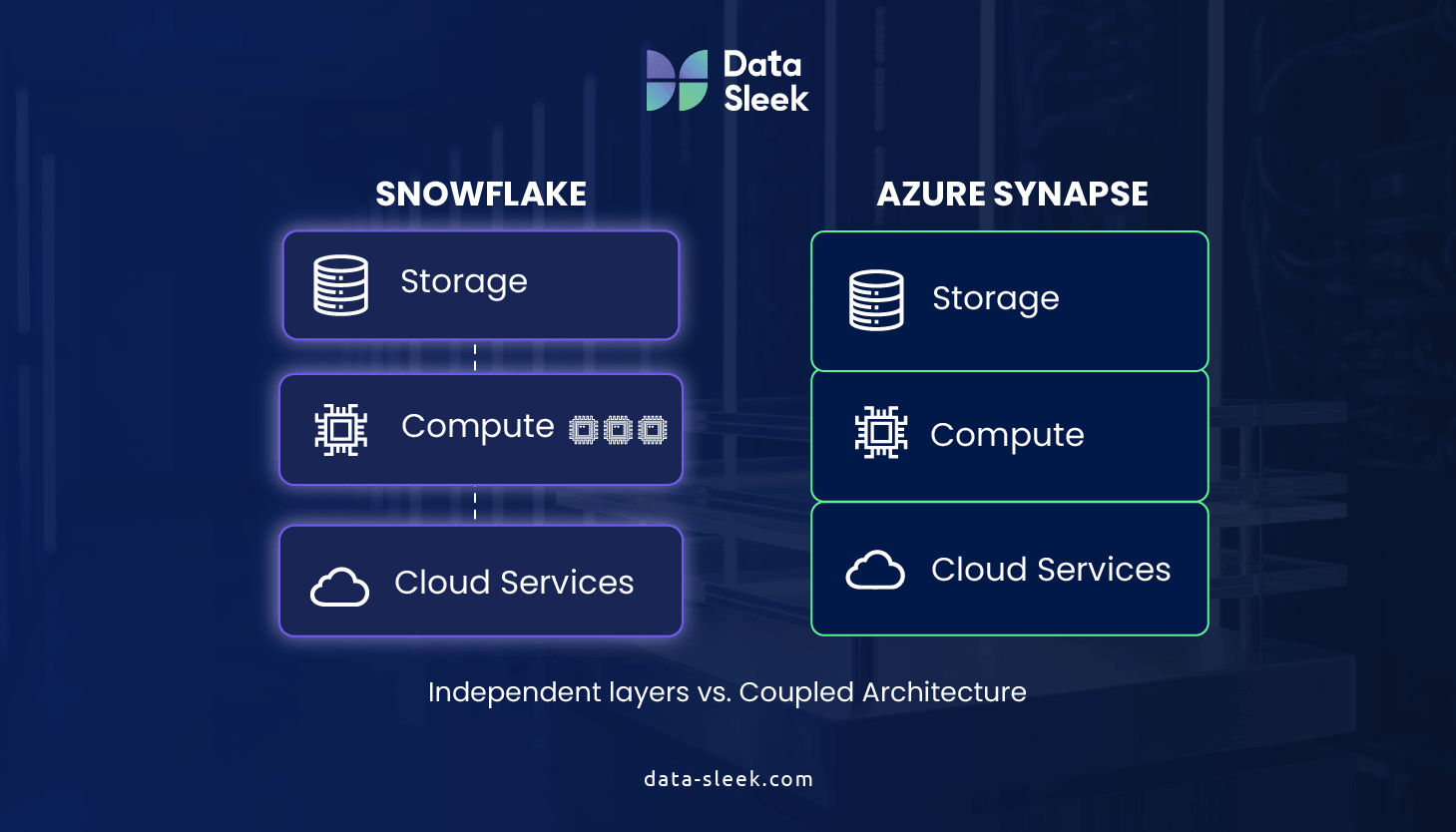
The practical consequence is genuine workload isolation, where a reporting team running heavy dashboard queries does not compete for resources with a data engineering team running transformation jobs. Snowflake bills by the second for active compute, and an idle warehouse that has been auto-suspended costs nothing on the compute side.
In 2026, Snowflake added a fully managed PostgreSQL layer through its Crunchy Data acquisition. Snowflake Postgres became generally available in February 2026, extending Snowflake’s capability beyond pure analytics into hybrid transactional and analytical processing workloads, with significant implications for organizations currently running Azure SQL Database or Cosmos DB alongside Synapse.
How Azure Synapse and Microsoft Fabric Were Designed
Azure Synapse Analytics uses a massively parallel processing architecture derived from Microsoft’s SQL Server and Azure SQL DW heritage, integrating tightly with Azure Data Lake Storage Gen2, Azure Active Directory, and Azure DevOps. That depth of integration is a genuine strength for organizations already standardized on Microsoft tooling, and a source of complexity for those that are not.
Synapse offers two compute models. Dedicated SQL pools provision a fixed amount of compute capacity and bill for that capacity whether or not queries are running. Serverless SQL pools query data on demand and bill per terabyte processed. Microsoft Fabric, as the successor platform, shifts toward a SaaS model with OneLake as the unified storage layer and a single capacity billing model covering all Fabric workloads under one SKU.
Architecture comparison
| Capability | Snowflake | Azure Synapse / Fabric |
| Compute and storage separation | Fully independent | Yes, in Fabric Lakehouse; Synapse dedicated pools are coupled |
| Multi-cloud support | AWS, Azure, and GCP | Azure-native |
| Concurrency model | Multi-cluster auto-scaling, independent virtual warehouses | Resource classes and workload groups |
| Architecture origin | Purpose-built cloud SQL (SIGMOD 2016) | MPP SQL Server heritage |
| Open format support | Apache Iceberg, Parquet, Delta Lake | Delta Lake, Parquet, Iceberg ( via OneLake) |
| HTAP capability | PostgreSQL-compatible layer (GA Feb 2026) | Azure SQL and Synapse as separate services |
Pricing Framework: Variables, Not Vendor Numbers
Both platforms update pricing continuously, and any specific figure published online is either stale or about to become stale. What matters is understanding how costs accumulate on each platform and which variables determine whether Snowflake or Fabric is cheaper for your specific situation.
How Snowflake pricing works
Snowflake uses a consumption-based credit model where compute and storage are billed separately. Organizations pay for active query time, not provisioned capacity, which benefits workloads with variable or unpredictable query patterns. Auto-suspend kicks in after a configurable idle period, stopping the credit meter. The risk is unintended credit consumption: large virtual warehouses left running, runaway queries, or poorly governed access patterns can produce billing surprises. Credit governance is an operational discipline, not an optional configuration.
How Azure Synapse and Fabric pricing works
Azure Synapse dedicated SQL pools use a Data Warehouse Unit model where compute capacity is provisioned and billed whether or not queries are running. This is cost-efficient for consistently high-utilization workloads but expensive for intermittent use. Microsoft Fabric’s capacity model consolidates billing under Fabric Capacity Units, which cover all Fabric workloads under a single capacity reservation. For organizations already paying for Power BI Premium, the Fabric model can represent meaningful cost consolidation.
Factors that favor Snowflake cost efficiency
- Unpredictable or spiky query patterns, where auto-suspend prevents idle spend between workload peaks.
- Teams that historically struggle to pause provisioned resources consistently.
- Multi-cloud data sharing requirements where egress workarounds would otherwise add cost.
- Organizations without an existing Azure enterprise agreement.
Factors that favor Synapse and Fabric cost efficiency
- Existing Azure enterprise discount agreements, where Microsoft may apply Fabric capacity against existing commitments.
- Predictable, high-concurrency workloads where reserved capacity is fully utilized.
- Teams already licensed for Azure Data Factory, Azure Active Directory, and Power BI, where integration costs are already sunk.
- Consistent sustained utilization where provisioned capacity is cheaper per query than Snowflake’s consumption model.

Which Platform Actually Fits Your Stack?
The right answer depends on your Azure footprint, workload patterns, and existing licensing. We’ll work through the math against your specific environment.
Already All-In on Azure? The Honest Integration Calculation
The most common question we hear from practitioners is some version of: “We run Azure Data Factory, Azure DevOps, Azure Active Directory, and Power BI. Does Synapse win by default?” It is a reasonable question, and it deserves a direct answer.
Organizations deeply invested in the Microsoft Azure ecosystem gain meaningful integration and licensing advantages with Azure Synapse and Microsoft Fabric that Snowflake on Azure cannot fully replicate. This reflects real integration depth: native role-based access control through Azure AD, direct Power BI dataset connectivity without data movement, Azure Data Factory pipeline reuse, and Microsoft enterprise agreement credits that may apply to Fabric capacity.
Snowflake runs natively on Azure but does not inherit Azure enterprise discount agreements or native Azure AD role-based access control at the same depth. Snowflake supports SAML and SCIM-based integration with Azure AD, and connectors exist for Azure Data Factory, but these are integrations built on top of an independent platform. The gap is manageable, but it is real, and it has a cost.
Score your situation against these factors to get a clearer answer:
- Active Azure enterprise agreement with committed spend? Synapse and Fabric advantage.
- Power BI Premium on a P-SKU or F-SKU capacity with Fabric features enabled? Fabric Direct Lake mode is effectively cost-free in context. Organizations on Power BI Premium Per User (PPU) do not have access to Direct Lake and should verify their capacity tier before factoring this into a TCO comparison.
- Azure Data Factory pipelines in production? Migration cost to Snowflake is real. Every pipeline that touches your warehouse would need to be rebuilt.
- Multi-cloud strategy planned or in progress? Snowflake is the clear winner.
- Live data sharing with external partners required? Snowflake Data Clean Rooms is a differentiated capability. Fabric’s approach to external sharing is less mature.
If four or more of the first four items apply to your organization, the integration case for Fabric is strong. If multi-cloud or external data sharing are requirements, Snowflake earns serious consideration regardless of your Azure footprint.
Either way, the calculation looks different depending on your ADF pipeline count, your Power BI licensing tier, and your enterprise agreement structure. Talk to a data warehouse consultant if you want Data-Sleek to walk through it against your specific environment.
AI and ML in 2026: Snowflake Cortex vs Azure OpenAI and Synapse Spark
The AI workload question is now a real differentiator between these platforms. The concern we hear consistently from mid-market clients: they want AI capabilities on their data without building a data movement architecture to support them.
Snowflake Cortex AI
Snowflake Cortex provides built-in LLM functions, including COMPLETE, SUMMARIZE, SENTIMENT, and CLASSIFY, that run directly on data inside Snowflake without moving data to an external model endpoint. These are not API wrappers that call out to a hosted model. They execute within Snowflake’s managed infrastructure, which means data does not move to an external endpoint outside Snowflake’s contractual boundary.

However, Cortex inference runs on third-party GPU infrastructure with which Snowflake maintains agreements, and that infrastructure may not be in the same region as your Snowflake account. Organizations with strict data residency requirements — including healthcare clients operating under a BAA — should verify their specific Cortex model tier and regional configuration before treating this as a covered inference path.
For organizations with data residency requirements, the absence of an external API call is a meaningful reduction in data movement risk. Whether it satisfies your specific compliance posture depends on your Cortex model tier, your account’s region, and the scope of your BAA. Cortex Search extends this into vector search, supporting retrieval-augmented generation (RAG) patterns without an external vector database. Snowpark provides a Python, Java, and Scala execution environment inside Snowflake’s compute layer, supporting ML training, feature engineering, and model serving alongside SQL analytics on the same platform.
Azure OpenAI and Synapse Spark
Azure Synapse integrates with Azure OpenAI Service through REST API calls from Synapse notebooks or Synapse Spark. For organizations already operating within Azure’s compliance perimeter, the external call pattern is manageable because both services live within the same Azure tenant. The data movement concern is most acute for organizations mixing data from Azure and non-Azure sources, or those with contractual restrictions on data leaving a specific environment.
Microsoft Copilot in Fabric brings AI-assisted pipeline building, query generation, and schema migration into the Fabric experience. For data engineering teams that are not ML practitioners, Copilot’s ability to generate SQL and build pipelines in natural language is a practical productivity accelerator.
Synapse Spark runs on Apache Spark, with access to the full open-source ecosystem including PySpark, SparkML, and MLflow. Snowpark gives Python, Java, and Scala developers a familiar execution environment inside Snowflake’s compute, but it is not Apache Spark. Teams with deep Spark expertise and Spark-native ML pipelines will find Synapse Spark a more natural fit.
AI and ML capability comparison
| Capability | Snowflake | Azure Synapse / Fabric |
| In-warehouse LLM inference | Cortex AI, native, no data movement | Azure OpenAI via REST API, external endpoint |
| Python and Scala ML workloads | Snowpark | Synapse Spark (Apache Spark) |
| Data movement for AI | No external endpoint; regional co-location not guaranteed | Requires external calls for OpenAI integration |
| Vector and semantic search | Cortex Search | Azure AI Search, separate service |
| MLflow integration | Yes | Yes |
| AI-assisted development | Cortex Analyst | Microsoft Copilot in Fabric |
Snowflake’s 2026 Postgres Layer: What It Means for HTAP Workloads
This is the development that most existing comparisons have not addressed, and it changes a foundational assumption that enterprise data architects have been operating on for years.
The traditional pattern in mid-market data architecture has been two separate platforms: a transactional database (Azure SQL, Azure Cosmos DB, or PostgreSQL) for OLTP workloads, and a data warehouse for analytical workloads. Building ETL pipelines to move data between the two tiers has been standard practice.
In 2025, Snowflake acquired Crunchy Data and launched Snowflake Postgres, a fully managed PostgreSQL-compatible transactional layer that reached general availability in February 2026. This challenges the traditional pattern of using Azure SQL for transactions alongside Synapse for analytics. Mid-market enterprises now have a viable single-platform option in Snowflake for both workload types, one that can substantially reduce the ETL tier between transactional and analytical systems. Snowflake Postgres and the core analytics engine remain separate compute surfaces in the current GA release — native query federation between them is not yet available. The consolidation story is real, but the ETL layer shrinks rather than disappears at this stage.
The consolidation argument does not yet apply to high-velocity transactional workloads such as payment processing, real-time inventory management, or systems with sub-millisecond latency requirements. Those workloads require purpose-built OLTP engines. But for mid-market enterprises running moderate transaction volumes alongside substantial analytical workloads, the single-platform option is worth tracking.
Industry-Specific Considerations
Healthcare: HIPAA and PHI Workloads
Both Snowflake and Microsoft Fabric support HIPAA-compliant configurations, but organizations must sign a Business Associate Agreement (BAA) with each provider. Neither platform is HIPAA-compliant by default without explicit configuration and contractual coverage.

Azure Synapse and Microsoft Fabric inherit Azure’s comprehensive compliance portfolio, including FedRAMP, HITRUST, and HIPAA, through the Azure platform. If your organization has already completed an Azure compliance audit, Fabric inherits that posture without requiring a separate infrastructure-layer audit. Snowflake maintains its own compliance certifications, including HIPAA, but organizations migrating from Azure need to account for the re-certification effort.
- BAA availability: Both Snowflake and Azure offer BAAs. Confirm scope of coverage against your specific PHI use cases.
- PHI data residency: Azure region-locking is native and straightforward. Snowflake requires explicit configuration at account creation.
- Compliance inheritance: Healthcare organizations already HIPAA-audited on Azure benefit from Fabric’s inherited compliance posture, reducing the burden of a net-new compliance review.
- Audit logging: Both platforms support the comprehensive audit trails HIPAA requires. Verify log retention periods with your compliance officer before finalizing platform selection.
Insurance: Data Residency and Regulatory Reporting
State-level data residency requirements in insurance create a governance pattern that Azure’s regional deployment model handles naturally. Fabric inherits that boundary. Snowflake’s regional account structure supports residency requirements but requires explicit configuration verified against your specific state-level obligations.
- Actuarial workloads: Both platforms handle heavy SQL analytics equivalently well. The decision for insurance organizations is governance and integration, not raw query performance.
- Regulatory reporting pipelines (NAIC, IFRS 17): Azure’s native connectivity to Microsoft-ecosystem reporting tools is an integration advantage for Synapse and Fabric. Snowflake supports these pipelines but requires connector configuration.
- Data sharing with reinsurers: Snowflake Data Clean Rooms allows secure live data collaboration without raw data exposure. Sharing loss data or actuarial assumptions with a reinsurer without moving raw policy data outside your governance boundary is a meaningful operational improvement over file-based sharing.
Construction: Operational Data and Document Workloads
Construction data is rarely clean. The mix of structured project cost data, semi-structured IoT telemetry, and unstructured document data from blueprints, permits, and change orders creates a platform demand that generic enterprise comparisons do not address.
- OCR and document ingestion: Azure Cognitive Services integration is native with Synapse and Fabric. For organizations processing high volumes of scanned blueprints and permit documents, the native Azure document AI pipeline offers a meaningful acceleration.
- IoT sensor data from equipment fleets: Azure IoT Hub to Synapse and Fabric is a native pipeline. Snowflake requires an external connector and additional ETL configuration.
- ERP integration (Procore, Viewpoint, Sage): Verify native connector availability and Fivetran or Airbyte ingestion support, plus dbt transformation compatibility, for each platform against your specific ERP version.
Higher Education: Cost Sensitivity and Open-Source Compatibility
Higher education institutions face budget constraints that make the licensing arithmetic of this decision unusually consequential. The right answer in a commercial mid-market context may not be right for an institution running on grant funding with a Microsoft Campus Agreement already in place.
- Budget constraints: Both platforms offer academic and research pricing programs. Verify eligibility through your Microsoft Campus Agreement for Fabric, or through Snowflake’s education program, before finalizing any TCO comparison.
- Open-source stack compatibility: Snowflake’s Snowpark and Apache Iceberg support pair well with dbt and Airflow. Fabric’s Delta Lake and Apache Spark are equally compatible. Neither platform creates friction with open-source tooling at the orchestration layer.
- Microsoft Campus Agreements: Institutions already paying for Microsoft 365, Teams, and Power BI may find Fabric represents a near-zero incremental licensing cost for data warehouse capability.
- Research data sharing: Snowflake Data Clean Rooms supports secure cross-institution data collaboration without raw data exposure, a technically elegant solution for clinical data consortia currently managing data sharing through manual agreements and file transfers.
The platform decision shifts meaningfully depending on your vertical — the compliance posture, licensing agreements, and data sharing requirements each industry brings to the table are variables that a generic comparison cannot resolve. If you want to see how Data-Sleek approaches these trade-offs by industry, see our industry solutions.

Migration Reality: The Cost of Getting to Each Platform
If you’ve already decided your destination using the framework above, this section answers a different question: how much work does it take to get there from Synapse? The two paths below aren’t alternatives to each other — they’re the price tag attached to each platform choice.
For organizations currently running Azure Synapse, the migration decision is where the abstract platform comparison becomes a concrete project plan. The two viable paths are meaningfully different in tooling maturity, engineering complexity, timeline, and strategic outcome.
Migrating Azure Synapse to Microsoft Fabric
Microsoft’s Fabric Migration Assistant automates schema conversion, table migration, view migration, stored procedure conversion, and security object migration from Azure Synapse dedicated SQL pools, with AI Copilot assistance for compatibility errors that require manual resolution. The assessment-first approach means you can understand your compatibility posture and the scope of manual remediation before committing to the migration.

The direct-connection migration method from Azure Synapse to Microsoft Fabric remains in preview as of mid-2026. Organizations requiring a fully GA migration path should use the DACPAC file-based method, which is generally available.
- Migration tooling: Fabric Migration Assistant (GA), with a PowerShell automation tool for ADF and Synapse pipeline migration to Fabric Data Factory.
- SQL dialect gap: Minor. T-SQL compatibility between Synapse and Fabric is high.
- Pipeline rebuilding: Minimal. Azure Data Factory pipelines migrate to Fabric Data Factory with the PowerShell upgrade utility.
- Identity and access: Azure AD carries over natively. No SCIM or SAML reconfiguration required.
- Timeline: One to four months for a mid-market environment, depending on stored procedure complexity, data volume, and external pipeline dependencies.
- Strategic outcome: Stays within the Microsoft ecosystem. No net-new vendor contract.
Migrating Azure Synapse to Snowflake
The Synapse-to-Snowflake migration path has real benefits, including platform independence, multi-cloud flexibility, and Snowflake’s architectural advantages for variable workloads. But it is a materially more complex project than the Fabric path, and organizations should scope it honestly before committing.
- Schema conversion: SQL dialect differences between Synapse T-SQL and Snowflake SQL require conversion tooling (SnowConvert or equivalent) or manual rewrite. Specific T-SQL functions, data types, and procedural constructs do not have direct Snowflake equivalents.
- Stored procedures: T-SQL to Snowflake Scripting conversion is the highest-effort component of most migrations. Procedures that encode complex business logic often require a developer to review and rewrite rather than mechanically translate.
- Data pipelines: Azure Data Factory pipelines cannot migrate directly to Snowflake. They must be rebuilt or replaced with dbt, Fivetran, Airbyte, or equivalent cloud data integration tooling.
- Identity: Azure AD to Snowflake integration via SCIM and SAML is well-documented but requires setup and testing. It is not automatic.
- Timeline: Realistically three to nine months for a mid-market environment, depending on schema complexity, stored procedure count, and pipeline volume.
- Strategic outcome: Platform independence. Net-new Snowflake contract and full migration project investment required.
Migration effort by destination
| Factor | Synapse to Fabric | Synapse to Snowflake |
| Migration tooling | Fabric Migration Assistant (GA) | Third-party (SnowConvert) or manual |
| SQL dialect gap | Minor | Moderate, T-SQL to Snowflake SQL |
| Pipeline rebuilding | Minimal, ADF migrates to Fabric Data Factory | Significant, full pipeline rebuild required |
| Identity and access | Azure AD carries over natively | SCIM and SAML setup required |
| Timeline estimate | One to four months | Three to nine months |
| Licensing change | Azure EA, potentially included | Net-new Snowflake contract |
| Strategic outcome | Stays in Microsoft ecosystem | Platform independence |

Decision Framework: When to Choose Each Platform
The Fabric vs. Snowflake decision in 2026 is fundamentally a choice between ecosystem alignment, where Microsoft Fabric offers the deepest Azure integration, and architectural independence, where Snowflake’s multi-cloud design and emerging HTAP capabilities provide the most flexibility for enterprises without a single-vendor commitment.
| Your situation | Recommended platform |
| All-in on Azure + Power BI + Azure Data Factory pipelines | Microsoft Fabric |
| Multi-cloud strategy planned or underway | Snowflake |
| No existing cloud vendor preference | Snowflake (architecture advantage) |
| Healthcare or regulated industry, already on Azure | Microsoft Fabric (compliance inheritance) |
| Need transactional + analytical on a single platform | Snowflake (Postgres layer GA Feb 2026; ETL layer reduced, not eliminated) |
| Budget-constrained with existing Microsoft EA | Microsoft Fabric |
| Existing Snowflake users expanding platform use | Snowflake |
| Migrating from Synapse, want lowest engineering effort | Microsoft Fabric |
| Cross-org data sharing without ETL pipelines required | Snowflake (Data Clean Rooms) |
Frequently Asked Questions (FAQ)
Is Azure Synapse being discontinued?
Microsoft has not announced a forced deprecation timeline for Azure Synapse Analytics as of mid-2026. Microsoft’s strategic direction is Microsoft Fabric — a SaaS analytics platform that consolidates Synapse’s capabilities alongside Power BI, Azure Data Factory, and real-time analytics under a single OneLake-based architecture. New enterprise investments should be evaluated against Fabric’s roadmap rather than Synapse’s.
Which platform is cheaper, Snowflake or Microsoft Fabric?
Neither platform is categorically cheaper — the cost difference depends on your workload pattern and existing licensing. Snowflake’s consumption-based credit model favors unpredictable or spiky workloads where auto-suspend prevents idle spend. Microsoft Fabric’s capacity model favors organizations with consistent, high-utilization workloads and existing Microsoft enterprise agreements where Fabric capacity may apply against committed spend. Verify current rates at the Azure Pricing Calculator and Snowflake’s pricing page before finalizing any TCO analysis.
Should I choose Snowflake or Microsoft Fabric if I’m already heavily invested in Azure?
Organizations running Azure Data Factory, Power BI, Azure Active Directory, and an active Azure enterprise agreement gain real integration and licensing advantages with Microsoft Fabric that Snowflake on Azure cannot fully replicate. If four or more of those dependencies apply to your environment, the Fabric case is strong. If multi-cloud flexibility or cross-organization data sharing without ETL pipelines are requirements, Snowflake earns serious consideration regardless of your Azure footprint.
Should I wait for Snowflake’s Postgres layer to go GA before evaluating it?
Snowflake Postgres is generally available as of February 2026, so there is nothing to wait for. The more relevant question is workload fit; it handles moderate OLTP workloads alongside analytics well, but sub-millisecond latency requirements still warrant a purpose-built OLTP engine. Data-Sleek can help scope whether it fits your specific workload profile.
How long does it take to migrate from Azure Synapse to Snowflake?
A Synapse-to-Snowflake migration realistically takes three to nine months for a mid-market environment, depending on schema complexity, stored procedure count, and pipeline volume. The primary effort drivers are T-SQL to Snowflake SQL conversion, stored procedure rewrites for complex business logic, and full pipeline rebuilds — Azure Data Factory pipelines cannot migrate directly to Snowflake. The Synapse-to-Fabric path runs shorter at one to four months, because Microsoft’s Fabric Migration Assistant automates most schema and pipeline migration.
How Data-Sleek Approaches This Decision
Every platform decision Data-Sleek makes with clients follows the same three-phase methodology: Contextualization, Ideation, and Implementation.
Contextualization means understanding the client’s existing infrastructure, team capacity, compliance posture, and data maturity before evaluating platforms. The right platform for a healthcare organization already on Azure with an active enterprise agreement looks different from the right platform for a construction company on a greenfield build.
Ideation means generating the viable paths given that context: build vs buy, migration vs greenfield, single-vendor vs multi-cloud, and the specific tradeoffs each carries. Implementation means executing the chosen path with senior-led engagement rather than handing off a recommendation document.

Ready to Make the Call?
One 30-minute call produces a clear platform recommendation your leadership can act on.


