
The promise of data has always been clear for many enterprises, but the reality is often messier. Fragmented systems, inconsistent data quality, and painfully manual processes usually prevent timely, trustworthy insights. As data volumes continue to explode, traditional data warehousing services struggle to keep up.
Enter artificial intelligence.
AI is no longer a futuristic idea; it’s a driving force for smarter, faster, and more automated decision-making. A Forbes Advisor survey found that 64% of businesses believe AI will significantly boost productivity. And with the global AI market expected to reach $1.81 trillion by 2030, its impact is undeniable.
Wondering if your data infrastructure is ready for AI?
Data-Sleek’s AI Consulting Services help organizations assess readiness, identify high-value use cases, and build AI on a solid data foundation.

But realizing AI’s full impact requires overcoming technical and organizational challenges. Scaling AI within legacy systems or fragmented environments demands strategic alignment — not just new tools. This article explores how AI is transforming every layer of the data warehouse, from automated pipelines and data quality to predictive analytics and self-optimizing infrastructure, and what that means for data-driven businesses.
The Evolution of Data Warehousing
Data warehousing emerged in the late 1980s as a centralized repository to store integrated data from multiple sources for reporting and analysis. Over the years, these systems evolved into more sophisticated platforms, enhancing data aggregation, storage, and retrieval. With the advent of big data and cloud computing, data warehousing became more scalable, flexible, and cost-effective.
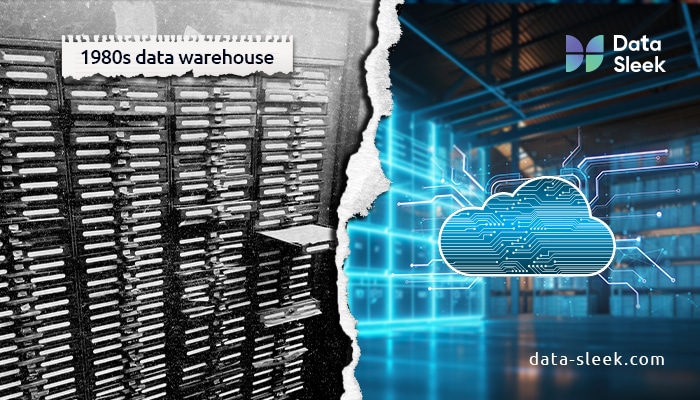
Today, a data warehouse is no longer a passive storage layer. It’s an intelligent system capable of predictive analytics, real-time data analysis, and actionable insights — marking a fundamentally new chapter in how organizations manage and extract value from their data.
The Emergence of AI in Data Management
The integration of AI into modern data warehouses marks a major shift in how organizations manage, analyze, and act on data. What was once a passive storage layer is now becoming an intelligent platform that can automate workflows, improve data quality, and power advanced analytics in real time. For many organizations, realizing these benefits requires aligning data strategy, infrastructure, and talent — not just adding new tools.
Two AI-driven innovations stand out for their transformative impact: Machine Learning and Natural Language Processing.
Machine Learning in Modern Data Warehouses
ML algorithms are integrated into modern data warehouse platforms to build predictive models that enhance data analysis and decision-making. These algorithms can identify patterns and anomalies in large data sets that would be impossible for humans to detect manually.
For instance, ML can forecast future trends based on historical data stored in the warehouse, enabling businesses to make proactive decisions, anticipate market changes, and personalize customer experiences. In real-time data warehouses, AI also automates governance tasks such as data quality checks, classification, and anomaly detection — helping ensure the data in the warehouse is accurate, consistent, and reliable.
Natural Language Processing in Data Warehousing
NLP enhances accessibility by allowing users to query data using plain language. This democratizes analytics across departments, enabling business users to generate insights without needing SQL expertise.
NLP is also instrumental in extracting insights from unstructured data sources such as emails, survey responses, or customer feedback, adding a new dimension of analysis to the data warehouse.
In construction, these capabilities extend to physical documents. OCR for construction data and analytics applies multimodal AI to extract structured data from contracts, budgets, and architectural drawings, feeding it directly into data warehouses for real-time project insights.
AI in OLAP vs. OLTP: Different Roles, Different Outcomes
A subtle but essential distinction lies in how AI is applied across OLAP (Online Analytical Processing) and OLTP (Online Transaction Processing) systems. In OLAP environments like data warehouses, AI is focused on strategic intelligence: predicting trends, surfacing anomalies, and enhancing business decision-making through analytics. These systems operate on large volumes of historical or curated data and support use cases like sales forecasting, regulatory compliance analysis, or executive dashboards.
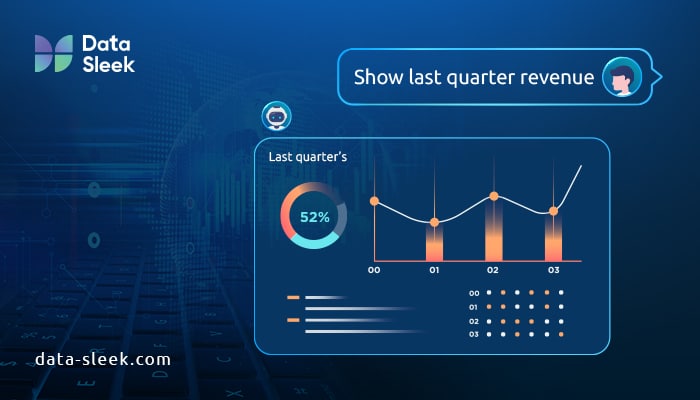
In contrast, OLTP systems (such as CRM platforms, payment gateways, or logistics apps) leverage AI for real-time operational responses — instant fraud detection, chatbot assistance, or transaction risk scoring, where low latency and transactional accuracy are critical.
For organizational leaders, this distinction matters. AI-enhanced data warehouses improve cross-functional alignment and long-term planning, while AI in OLTP systems fuels customer-facing agility. Understanding where to apply AI across the stack shapes architecture choices, resource allocation, and governance strategy. Formalizing that into an AI governance framework gives mid-market teams the structure to manage model risk and compliance as AI scales.
AI-Driven Data Warehouse: Key Advancements
Automated Data Integration
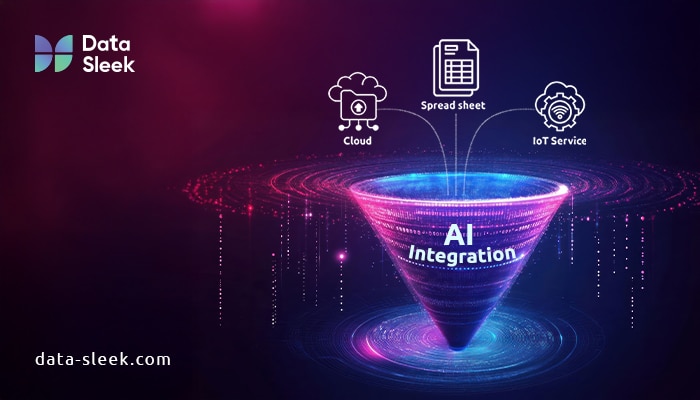
AI simplifies the traditionally complex process of aggregating data from multiple sources — databases, cloud platforms, SaaS apps, and IoT devices. By automating ELT pipelines, AI accelerates data ingestion, reduces manual intervention, and assists in standardizing formatting by detecting inconsistencies and recommending transformations. This enables near real-time data availability for analytics and more agile decision-making.
This transition is especially transformative in data-heavy industries. Construction firms can leverage these advancements through construction data warehousing, where automated integration from Procore, BIM, and financial systems delivers predictive insights for better project planning and cost control. For organizations processing document-heavy sources, AI-powered OCR workflows with n8n automatically extract structured data from PDFs, invoices, and forms.
Enhanced Data Quality and Governance
Maintaining clean, trustworthy data has always been a challenge in large-scale systems. AI improves data quality through automated error detection, deduplication, and intelligent classification. It flags inconsistencies in real time and applies rules-based or learned corrections without manual data wrangling.
AI also supports compliance by tagging sensitive data, enforcing access controls, and helping organizations meet evolving privacy regulations like GDPR or HIPAA more efficiently.
Data Observability and Metadata Intelligence
AI is essential to data platforms’ operational reliability. Tools like Monte Carlo and Metaplane use AI to monitor data pipelines, detect upstream failures, and identify anomalies before they reach dashboards. Platforms such as Collibra, Atlan, and Alation leverage AI to automate metadata management — data lineage mapping, cataloging, and sensitive data classification — ensuring transparency and governance across distributed data environments.
By embedding AI in observability and metadata workflows, organizations reduce manual oversight, maintain trust in their analytics, and scale governance across increasingly complex ecosystems.
Forecasting and Trend Analysis
AI enhances traditional analytics by uncovering trends and patterns that humans or rule-based systems might miss. Machine learning models can analyze historical data to project future outcomes, enabling use cases like demand forecasting, customer behavior prediction, and fraud detection.
With this capability embedded directly in the data warehouse, business teams can shift from reactive reporting to proactive, insight-driven strategy. The quality of these insights depends on building accurate models with relevant, high-quality features — AI delivers value only when grounded in sound data science practices.
Implementation Across Ecosystems
Leading platforms are embedding AI capabilities directly into their ecosystems. Snowflake offers Snowpark ML for in-warehouse model development. BigQuery ML enables SQL-based machine learning within Google Cloud. Azure Synapse, paired with Cognitive Services, supports NLP and vision models at scale. Databricks integrates with MLflow for lifecycle management. Even orchestration tools like DBT now offer AI-assisted transformations via integrations with OpenAI. These ecosystems allow businesses to implement AI in their data workflows without building infrastructure from scratch.
Case Studies: AI in Action within Data Warehousing
The promise of AI in data warehousing isn’t theoretical — it’s already reshaping how mid-market companies operate. The common thread across these projects: an AI-ready warehouse foundation has to come first, before predictive models, agents, or real-time intelligence can deliver value.
Tradesman Insurance — From Fragmented Reporting to Real-Time KPI Visibility
A growing insurance carrier was drowning in manual reporting and disconnected systems, leaving leadership without timely KPI visibility. Data-Sleek consolidated their data into a modern cloud warehouse on Snowflake, with Fivetran + dbt automating ingestion and transformation, and Tableau delivering role-based dashboards.
The outcome: a 90% reduction in manual reporting, 3× KPI visibility for leadership, and real-time customer behavior analysis that lets the team intervene on service drop-offs before they become churn. The same trusted, governed dataset now serves as the foundation for AI-driven underwriting and retention models.
Jabra Enhance — A HIPAA-Compliant Data Platform Behind a $94.8M Exit
Jabra Enhance’s hearing health platform pulled signals from EMRs, mobile apps, and customer service systems — but siloed pipelines slowed the product and put HIPAA compliance at risk. Data-Sleek unified everything into a single cloud data warehouse with encryption at rest and in transit, role-based access, and audit logging.
Unified, AI-ready data fueled triple-digit sales growth in 2021, ~$15M in annual revenue, and ultimately a $94.8M acquisition by GN Holdings in 2023. The lesson for AI in healthcare data warehousing: governance and unification aren’t blockers to AI — they’re prerequisites.
Digital Asset Research — From 40M Rows/Day to 15B Rows/Hour
Pricing 7,000+ digital assets means ingesting 250M+ trades daily — and DAR’s legacy stack buckled under the load, with outages costing ~$300K per hour. Data-Sleek re-engineered the warehouse engine to process 15 billion rows in under an hour (up from 40M/day), cut storage and management costs by 50%, and executed a zero-downtime migration.
The result: a 600% expansion of customer base and an infrastructure now capable of supporting real-time AI inference and anomaly detection at market scale.
Benefits of AI-Enhanced Data Warehousing
As organizations scale their AI initiatives, the underlying data platform becomes a critical success factor. Understanding the enterprise data warehouse benefits — from enabling advanced analytics to supporting AI-driven monetization — helps leaders justify long-term investment in modern data infrastructure.
Improved Efficiency
AI automates data collection, cleaning, quality monitoring, and pipeline orchestration — reducing manual intervention, minimizing errors, and freeing engineering resources for higher-value work.
Better Decision Making
AI-driven analytics enables decisions grounded not just in historical data but in predictive and proactive insights. Organizations can act with greater confidence when anticipating future trends and scenarios.
Scalability and Flexibility
AI-powered warehousing systems handle increasing data volumes and adapt to changes in structure, format, and sources — providing the agility to respond quickly to market shifts.
AI makes data warehousing less about moving data and more about unlocking insights, which changes how businesses think about strategy and growth.
Franck, CEO, Data-Sleek
Challenges in Integrating AI with Data Warehousing
While AI brings significant potential to data warehousing, implementation comes with complex financial, technical, regulatory, and cultural challenges.
High Implementation Costs
Integrating AI requires investment in technology, infrastructure upgrades, and specialized talent. For small to medium-sized businesses, strategic investment in the right foundation can unlock long-term ROI, even when upfront costs are substantial.
Architectural Complexity
AI introduces new components, including ML pipelines, orchestration frameworks, and model management systems, that must integrate seamlessly with existing warehouses. Many organizations struggle to operationalize AI at scale without strong data engineering expertise. That expertise gap is exactly what the embedded engineering model is built to close — senior engineers working inside your environment rather than delivering recommendations from outside it. Closing that gap also depends on data architecture consulting that designs systems for scalability and long-term success.
Before committing to large-scale AI integration, organizations benefit from evaluating whether their foundation can support it — across infrastructure, governance, data maturity, and organizational capability.
Data Privacy and Security
AI systems require access to vast amounts of sensitive data. Regulatory compliance with evolving frameworks like GDPR remains a top priority. Organizations that treat security and governance as foundational — rather than afterthoughts — are better positioned to scale AI responsibly.
Bridging the Skills Gap
The success of AI-enhanced data warehousing depends heavily on people. As organizations adopt advanced analytics and intelligent automation, many face a critical skills gap. In fact, the skills gap is one of several interconnected reasons why most AI projects fail before reaching production, particularly in mid-market firms where resources for specialized AI talent are limited.
Finding talent with the right blend of technical depth and data strategy experience is a major challenge. Roles like AI engineers, MLOps specialists, and cloud-native data architects are highly competitive. But these shortages also create an opportunity: forward-looking companies are responding by building internal capability through targeted upskilling programs — training existing data and IT teams in model deployment, data governance, and AI ethics to reduce dependency on external hires.
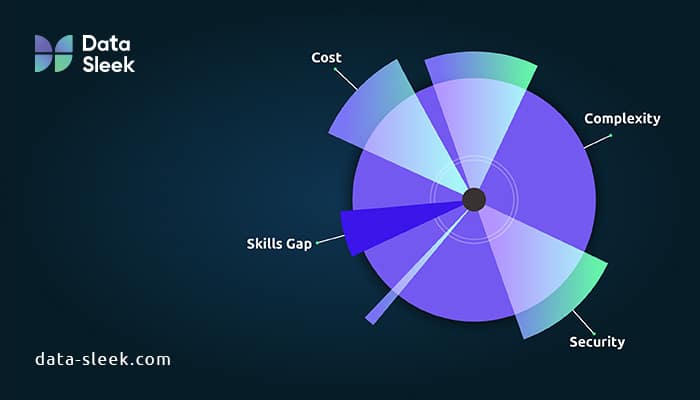
Beyond formal training, AI adoption requires a mindset shift. Teams need the freedom to experiment, fail fast, and continuously improve. Organizations that foster a culture of learning and cross-functional collaboration between data scientists, engineers, and business units are best positioned to evolve with the technology.
For most mid-market companies, winning a bidding war against AI labs for MLOps talent is not a realistic plan. The practical alternative is to rent the capability temporarily and keep the knowledge permanently — which is what an FDE-style engagement is structured to do, provided knowledge transfer is written into the contract rather than promised on the kickoff call.
The Future of AI-Driven Data Warehousing
AI is rapidly reshaping data warehouse capabilities. For a broader view of what’s ahead, our analysis of emerging data trends and future market shifts covers the technologies and strategic investments business leaders need to prioritize. Our AI/ML consulting services help teams design warehouse-native AI capabilities like these.
Near-Term: Real-Time AI and Full Automation
Organizations will see increasing automation of data quality checks, transformation logic, and pipeline orchestration. Real-time processing will become standard, turning warehouses from passive data stores into active decision engines.
Mid-Term: Deeper AI Integration
Data warehouses will incorporate deep learning, cognitive search, and automated anomaly detection, deriving meaning from unstructured data and surfacing hidden insights. Expect increased convergence between data warehousing, BI, and AI platforms into unified analytics environments.
The most advanced organizations are already taking this further — deploying an AI-native analytics layer built directly on the warehouse that replaces static dashboards with dynamic, investigation-driven answers.
Long-Term: Self-Optimizing Warehouses
The next evolution will be systems that use AI to continuously adjust their own storage, compute allocation, and performance settings — balancing cost, speed, and accuracy without human intervention. AI-driven security and compliance engines will detect breaches in real time, interpret regulatory changes, and automatically enforce policy updates.
Conclusion
AI is no longer a theoretical advantage in data warehousing — it’s a strategic imperative. As businesses strive to make faster, smarter decisions in real time, AI is transforming the data warehouse from a passive repository into an intelligent engine for growth.
But unlocking its full value requires more than deploying new tools. Organizations must modernize infrastructure, close skills gaps, and align people, processes, and platforms to support intelligent data operations. For organizations unsure whether their infrastructure, governance, and talent are ready to support AI at scale, an AI readiness assessment provides the diagnostic clarity needed before committing to transformation.
Ready to see where AI fits in your data strategy?
At Data-Sleek, we partner with companies to modernize their data infrastructure and implement practical, business-aligned AI solutions.
Talk to our AI consulting team about building a roadmap that fits your business, or book a free consultation to get started.


