
If you’re evaluating whether to bring in outside help for a data warehouse project, you’re not alone. Most mid-size companies reach a point where their data outgrows their infrastructure. Reports slow down, teams lose trust in the numbers, and decisions stall. This guide breaks down what data warehouse consulting actually involves, what the engagement process looks like, and how to choose a partner who fits your organization’s needs and budget.
Already know you need help? See our data warehouse consulting services.
Below, we’ll walk through the key phases of a consulting engagement, industry-specific applications, and what separates a good consulting partner from a great one.
Data Warehouse Consulting Key Takeaways
A data warehouse consultant handles the full lifecycle, from strategy and architecture design through implementation, testing, and ongoing optimization.
Typical engagements cover three phases: assessment and strategy, implementation and integration, and migration or optimization of existing systems.
Choosing the right partner comes down to relevant industry experience, platform certifications, a structured communication process, and demonstrated results through case studies. Data warehousing offers cost-effective scalability when the underlying architecture is built and maintained correctly.
Understanding Data Warehouse Consulting
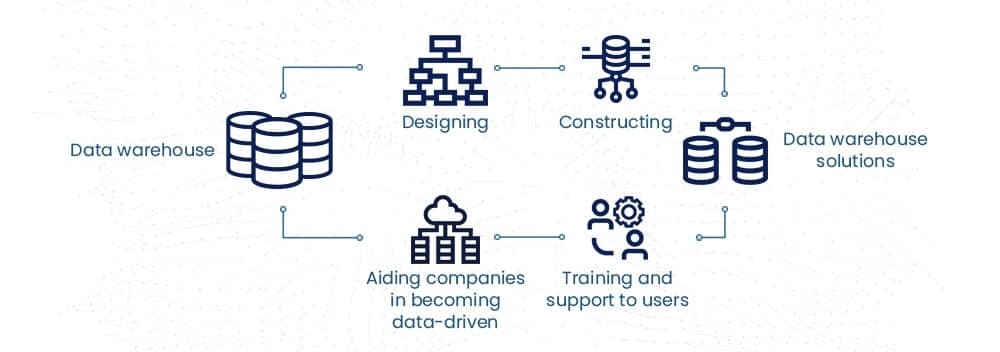
Data warehouse consulting is a service that assists organizations in designing, constructing, and sustaining data warehouses to meet their business objectives. These data warehouses are systems used for collecting and managing data from various sources within an organization, allowing them to generate meaningful business insights.
By facilitating analytical work, data warehouses enable transactional databases to focus on day-to-day transactions, ensuring real-time data accuracy.
The Role of Data Warehouse Consultants
Data warehouse consultants are responsible for designing, implementing, and maintaining data warehouse solutions, providing training and support to users, and aiding companies in becoming data-driven. These experts possess multidisciplinary expertise, which is essential for the success of a data warehousing project.
Effective communication is critical to successful data warehouse consulting, ensuring that all stakeholders are aligned and the project is executed smoothly.
Key Benefits of Data Warehouse Consulting
Data warehouse consulting offers numerous benefits, such as standardization and consistency of data, expedited processing and increased storage capabilities, enhanced security protocols, master data management, continual optimization of infrastructure and cloud expenditures, and swifter results.
Companies can benefit from data warehouse consultants to successfully implement or upgrade an existing data warehouse. This enables organizations to make the most out of scalability and high-performance capabilities while being cost-effective. For budgeting, review the main data warehouse costs across implementation, cloud infrastructure, migration, and ongoing support.
Types of Data Warehouse Consulting Services
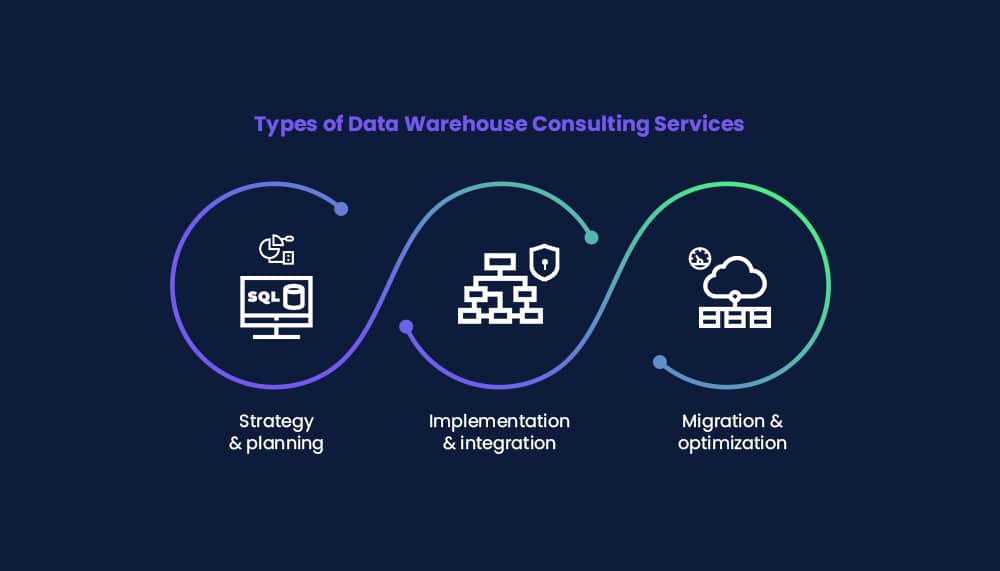
Data warehouse consulting services encompass many offerings, including strategy and planning, implementation and integration, and migration and optimization. These services address various needs, from conducting initial assessments to designing and deploying data warehouse solutions and even managing ongoing maintenance and optimization.
By tailoring their services to each organization’s unique needs, data warehouse consultants provide valuable support throughout the entire data warehousing process.
Strategy and Planning
The strategy and planning phase of data warehouse consulting is crucial in synchronizing the data warehouse with the organization’s strategic plan and providing constructive business insights. This phase involves investigating an existing environment, formulating an efficient data warehouse strategy, selecting the most appropriate data warehouse model, and constructing a prototype.
Whether you want to perform a data warehouse migration, optimize an existing data warehouse platform, or build a brand new one, strategy and planning a critical steps.
By meticulously strategizing and planning, data warehouse consulting services ensure that the resulting solution is aligned with the organization’s goals and requirements.
Implementation and Integration
The implementation and integration phase involves deploying the data warehouse architecture, data models, and ETL processes, ensuring that the solution meets the organization’s needs. Data warehouse consultants provide support services during this phase, such as making adjustments and changes as needed and offering overall support for the implementation process.
A well-structured and unified data warehouse guarantees regulated and secure access to data quality throughout an organization, allowing for improved decision-making and operational efficiency.
Migration and Optimization
Data migration and optimization are essential to data warehouse consulting, as they enable companies to enhance their data processing efficiency, consolidate data from various sources, detect and address bottlenecks, establish indexing, and make informed business decisions quickly. These services can reduce costs, enhance data accuracy, bolster data security, and enable faster decision-making.
A well-executed migration can dramatically reduce costs and query times. For example, see how Auto Rescue Solutions consolidated their data warehouse to streamline operations and improve reporting.
Data Warehouse Continuous Support
Data warehouse support is crucial for organizations seeking to maximize their investment in their data warehouse projects. Standard data warehouse support offers assistance in maintaining the integrity and accessibility of the data warehouse, performance optimization, and ensuring regulated and secure data access.
Industry-Specific Applications of Data Warehousing

Data warehousing services are regularly employed across various industries, including healthcare, retail, and finance. By tailoring data warehouse solutions to each sector’s unique needs and challenges, data warehouse consulting services enable organizations to harness the power of their data and derive valuable insights for operational purposes, analytics, and decision-making.
Let’s explore how data warehousing is utilized in these specific industries.
Healthcare
In the healthcare industry, data warehousing is a centralized repository for data obtained from multiple sources, then structured and processed for analysis. This facilitates healthcare providers to adopt a value-based approach towards healthcare delivery and patient-based care, enhancing the overall patient experience and optimizing clinical care.
Data warehousing also plays a crucial role in maintaining, reporting, and analyzing health policy records in the public sector.
Retail
Data warehousing is significant for the retail industry as it facilitates efficient data management, enhances customer experience, encourages loyalty and retention, and provides valuable insights for corporate decision-making. Retail chains utilize data warehousing for distribution, advertising, item tracking, analyzing customer purchasing behavior, and formulating pricing strategies.
By harnessing the power of big data together, retailers can make strategic decisions that drive growth and profitability.
Finance
Data warehousing plays a pivotal role in the finance industry, enabling the amalgamation and investigation of substantial amounts of financial information, which can benefit credit risk management, fraud detection, and market research. Finance teams can leverage data warehousing to investigate and comprehend critical metrics, identify fraud in revenue turnover and existing reports, and make informed decisions that drive business success.
By implementing robust data governance and security measures, data warehousing can also help finance organizations comply with regulations and reduce the risk of fraud.
Choosing the Right Data Warehouse Consulting Partner

Selecting the appropriate data warehouse consulting partner can significantly impact the success of your data warehousing project. To ensure a successful partnership, it is crucial to consider factors such as expertise and certifications, communication and collaboration, and track record and case studies.
By carefully evaluating potential partners, you can find a consulting partner that will meet your organization’s specific needs and drive business success through efficient and effective data warehouse implementation.
Expertise and Certifications
Expertise and certifications are essential for data warehouse consulting partners as they demonstrate proficiency and validate their qualifications in the field. Data warehouse consultants may obtain certifications from Snowflake, Oracle, Microsoft, and IBM, indicating proficiency in database design, data modeling, and data warehousing.
By choosing a consulting partner like Data-Sleek with relevant expertise and certifications, you can ensure that your data warehouse and project management will be executed efficiently and effectively, delivering the desired results for your organization.
Communication and Collaboration
Effective communication and collaboration are paramount for data warehouse consulting partners, as they assist teams in converging, promote collaboration and collective learning with incorporated data, and modify an organization’s culture by providing dependable data sets that can be utilized across the enterprise.
A consulting partner with solid communication and collaboration skills can help ensure that all stakeholders are aligned and that the project is executed smoothly, ultimately leading to a successful data warehouse implementation.
Track Record and Case Studies
A robust track record and case studies demonstrate a data warehouse consulting partner’s proficiency and experience in successfully executing customer data warehouse solutions. By evaluating a consulting partner’s track record and case studies, you can gain assurance in their capacity to deliver results and ensure the success of your data warehouse project.
Data-Sleek’s work with Tradesman Program Managers shows what that looks like in practice. Centralizing their MS-SQL data into a Snowflake warehouse using Fivetran and dbt cut manual reporting by 90% and tripled KPI visibility for leadership. A similar engagement with Sqquid reduced query latency from minutes to under 3 seconds, a gain that translated directly into a 25% lift in conversion.
The Data Warehouse Consulting Process
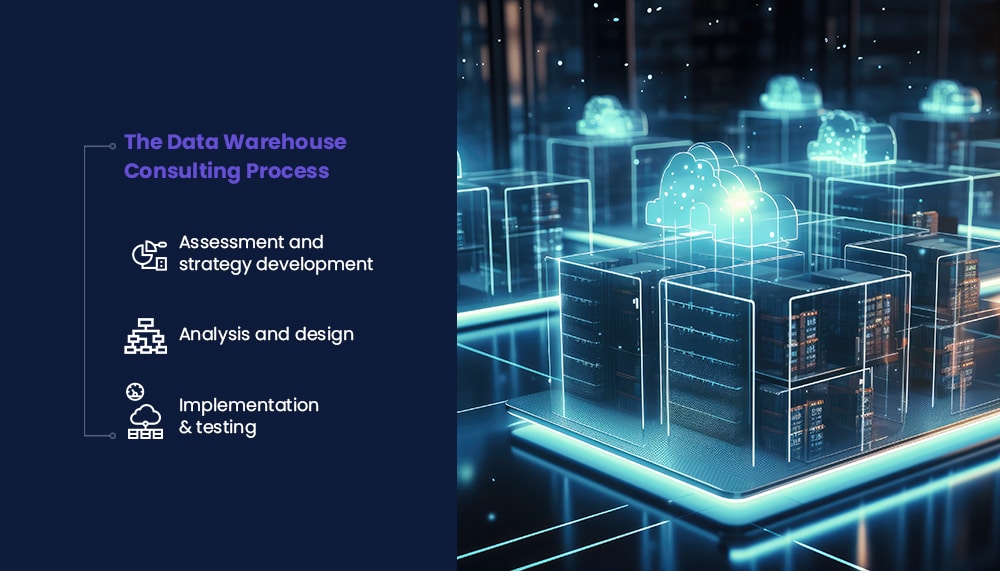
The data warehouse consulting process typically includes assessment and strategy development, analysis and design, and implementation and testing. Each phase is critical in ensuring the successful design, development, and deployment of a data warehouse solution tailored to an organization’s unique needs.
Following a structured process, data warehouse consulting services can guarantee that the solution meets the organization’s objectives and provides valuable insights to aid decision-making.
Assessment and Strategy Development
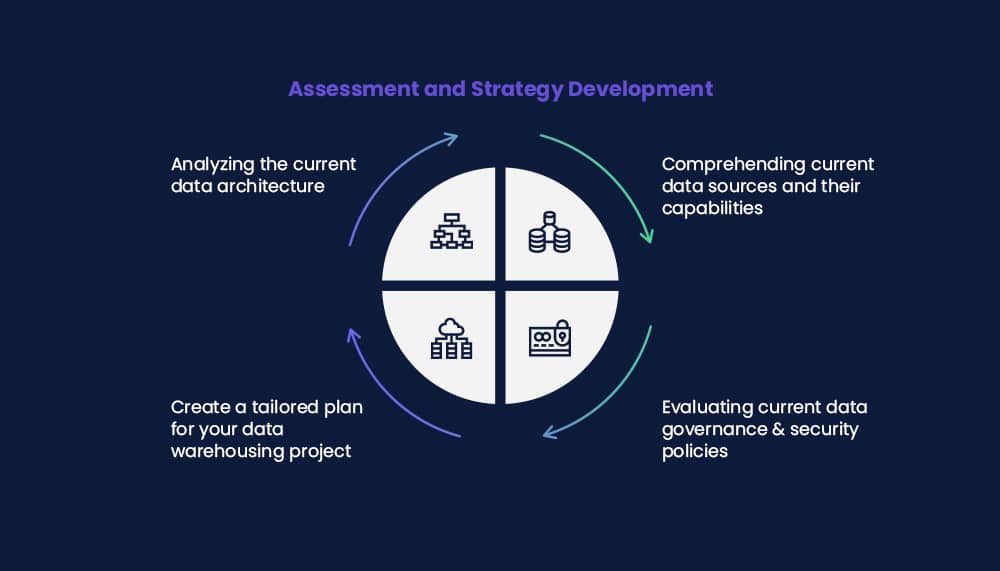
Assessment and strategy development are paramount for data warehouse consulting, as they assist in comprehending the organization’s preparedness, recognizing data requirements and analytics needs, and constructing a plan for accomplishing them.
By analyzing the current data architecture, comprehending current data sources and their capabilities, and evaluating current data governance and security policies, data warehouse consulting services can determine the organization’s readiness and create a tailored plan for your data warehousing project.
Analysis and Design
The analysis and design phase of data warehouse consulting ensures that the data warehouse is designed to meet the business’s precise needs. This phase involves gathering requirements, analyzing data sources, creating the data warehouse architecture logical design, and developing the data warehouse to meet the established requirements.
By focusing on analysis and design, data warehouse consultants can create a solution that provides a consistent view of customers and items, ultimately facilitating managing customer relationships and enhancing business productivity.
Implementation and Testing
Implementation and testing play a vital role in data warehouse consulting by guaranteeing that the system performs as anticipated, satisfies the client’s specifications, and exhibits high data quality and consistency. Data warehouse consultants employ various types of testing, such as unit testing, integration testing, data quality testing, system testing, user acceptance testing, and performance testing, to ensure the correct functioning of the data warehouse.
By rigorously testing the new data warehouse solution, consultants can identify and resolve any issues before the system going live, ensuring a successful implementation.
Best Practices for a Successful Data Warehouse Project
To ensure the success of your data warehouse, it is essential to adhere to best practices, such as aligning with business goals, implementing data governance and security, and focusing on continuous improvement and maintenance. By following these best practices, organizations can guarantee that their data warehouse projects are executed efficiently and effectively, delivering valuable insights that drive business success.
Aligning with Business Goals
Aligning with business goals is essential for a successful data warehouse, as it ensures that the project is pertinent to the organization’s objectives and can furnish valuable insights to aid decision-making. By identifying the organization’s objectives, comprehending the data warehouse project requirements, and formulating a plan to ensure the project meets its objectives, data warehouse consulting services can ensure that their projects align with the organization’s goals and requirements.
Data Governance and Security
Data governance and security are essential for the success of a data warehouse project, as they guarantee that data is precise, accessible, secure, and useful. Organizations should establish clear policies and procedures to implement effective data governance and security, implement access control measures, encrypt data, audit data usage, mask sensitive data, data mining for data quality, classify data, and set data retention policies.
By implementing robust data warehouse governance and security measures, organizations can ensure the integrity and protection of their data warehouse solutions.
Continuous Improvement and Maintenance
Continuous improvement and maintenance are essential for a successful data warehouse project, as they guarantee that the data warehouse remains pertinent and practical over time while optimizing performance and verifying that the data being stored and analyzed is precise and current. Organizations should regularly monitor the data warehouse for performance issues, ensure data accuracy and integrity, and regularly update the data warehouse with new data sources.
By focusing on continuous improvement and maintenance, organizations can ensure the long-term success of their data warehouse projects.
Summary
A data warehouse project is a significant investment, and the consulting partner you choose will shape the outcome. This guide covered the core phases of an engagement, how data warehouses are applied across healthcare, retail, and finance, and the criteria that matter most when evaluating a partner. If you’re at the point where you’re comparing options, the next step is a focused conversation about your current data environment and where you want to go.
Book a free data warehouse consultation.
Frequently Asked Questions
What does a data warehouse consultant do?
A data warehouse consultant designs, builds, and maintains the systems that turn scattered business data into a centralized, analysis-ready resource. This includes assessing existing infrastructure, recommending architecture changes, and supporting the team through implementation and testing.
What are the qualifications of a data warehouse specialist?
Most data warehouse consultants hold a bachelor’s degree in computer science or a related field, often paired with platform certifications from Snowflake, Oracle, Microsoft, or IBM. A master’s degree in business analytics is common but not required.
Is data warehousing in demand?
Demand continues to grow as more organizations shift to data-driven decision-making. Expect that trend to hold as data integration and warehousing needs expand across industries.
Who is the leading data warehouse vendor?
Snowflake is widely considered the leading data warehouse vendor, known for its scalability and modern analytics capabilities.
How long does a data warehouse implementation typically take?
It depends on scope, but most mid-size implementations take 8 to 16 weeks from kickoff to go-live. A phased approach, starting with a core data model and expanding iteratively, reduces risk and delivers value faster than a big-bang rollout.
What’s the difference between a data warehouse and a data lake?
A data warehouse stores structured, pre-processed data optimized for analytics and reporting. A data lake stores raw data in its native format, structured, semi-structured, or unstructured, for flexible exploration. Many modern architectures use both: the lake for ingestion and the warehouse for curated, business-ready datasets.


